Donkey Kong Country 4 Nes Rom — ((better))
The Donkey Kong Country series debuted in 1994 on the Super Nintendo Entertainment System (SNES) with the release of Donkey Kong Country. Developed by Rare, the game introduced 3D pre-rendered graphics, which were revolutionary at the time. The game's success spawned a series, with two sequels, Donkey Kong Country 2: Diddy's Kong Quest (1995) and Donkey Kong Country 3: Dixie Kong's Double Trouble! (1996), also released on the SNES.
If you want the authentic Donkey Kong Country experience, play the original SNES trilogy via official re-releases (Switch Online, Wii Virtual Console, or the DKC ports on GBA). For a true NES platformer with similar vibes, try Donkey Kong , Donkey Kong Jr. , or Donkey Kong 3 — but none are similar to the SNES DKC gameplay.
Given the high difficulty and lack of checkpoints, using emulator save states is highly recommended for a first-time playthrough. or help finding the correct emulator settings DONKEY KONG COUNTRY 4 ON NES?!
The title "Donkey Kong Country 4" was a marketing tactic to trick customers into thinking they were buying a brand-new adventure, though it is essentially a slimmed-down port of the first SNES game. Gameplay and Features |
 Modeling Nature and Physics is a growing practice for reaching
true-to-life systems simulations with 'alive' feedbacks, including complexity
management and unpredictability integration.
Modeling Nature and Physics is a growing practice for reaching
true-to-life systems simulations with 'alive' feedbacks, including complexity
management and unpredictability integration.
While in the past running an accurate Physical Modeling simulation was possible
(due to its complexity) only on expensive multi-processor workstations or even
computer clusters, today thanks to the exponential increase of modern CPUs' processing
power, reaching parity with real instruments is possible
in real-time (including polyphony and multi-istances possibilities) at a fraction of the costs.
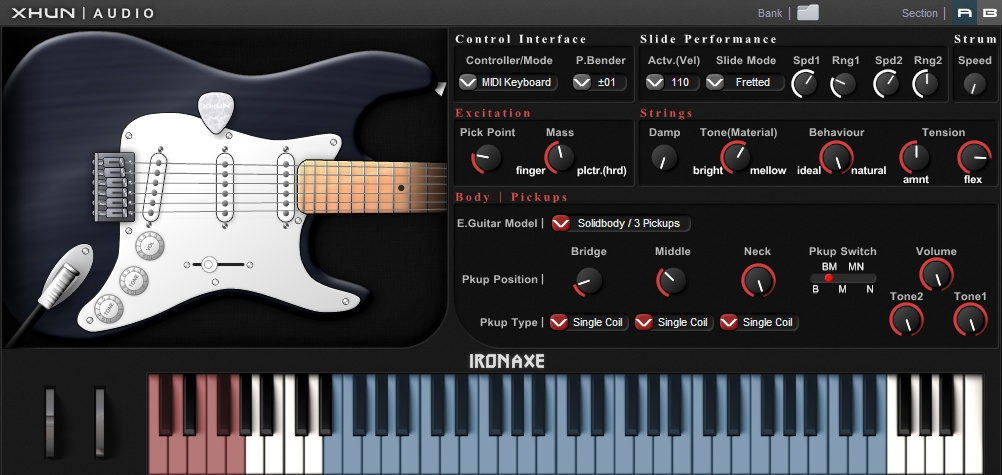
IronAxe is the first in a series of instruments developed by Xhun Audio to use this revolutionary technology.
The core of this kind of approach is the interaction between the Instrument's model, the Performer's model
and the Unpredictability simulation.
All the six Strings, the Transducers (Pickups), the Plectrum/Finger excitation and more as well
as Performer's actions like Palm Muting, Tapping Harmonics (even muting a String after
its excitation is possible) are physically simulated. Add Unpredictability (instrument's and
performances' micro-imperfections) to the equation and what you hear at the end of
the whole process is given by the interaction of this three worlds.
The result is an 'alive' instrument, a state-of-the-art simulation for an unparalleled realism.
|
|
The Donkey Kong Country series debuted in 1994 on the Super Nintendo Entertainment System (SNES) with the release of Donkey Kong Country. Developed by Rare, the game introduced 3D pre-rendered graphics, which were revolutionary at the time. The game's success spawned a series, with two sequels, Donkey Kong Country 2: Diddy's Kong Quest (1995) and Donkey Kong Country 3: Dixie Kong's Double Trouble! (1996), also released on the SNES.
If you want the authentic Donkey Kong Country experience, play the original SNES trilogy via official re-releases (Switch Online, Wii Virtual Console, or the DKC ports on GBA). For a true NES platformer with similar vibes, try Donkey Kong , Donkey Kong Jr. , or Donkey Kong 3 — but none are similar to the SNES DKC gameplay.
Given the high difficulty and lack of checkpoints, using emulator save states is highly recommended for a first-time playthrough. or help finding the correct emulator settings DONKEY KONG COUNTRY 4 ON NES?!
The title "Donkey Kong Country 4" was a marketing tactic to trick customers into thinking they were buying a brand-new adventure, though it is essentially a slimmed-down port of the first SNES game. Gameplay and Features
|
|