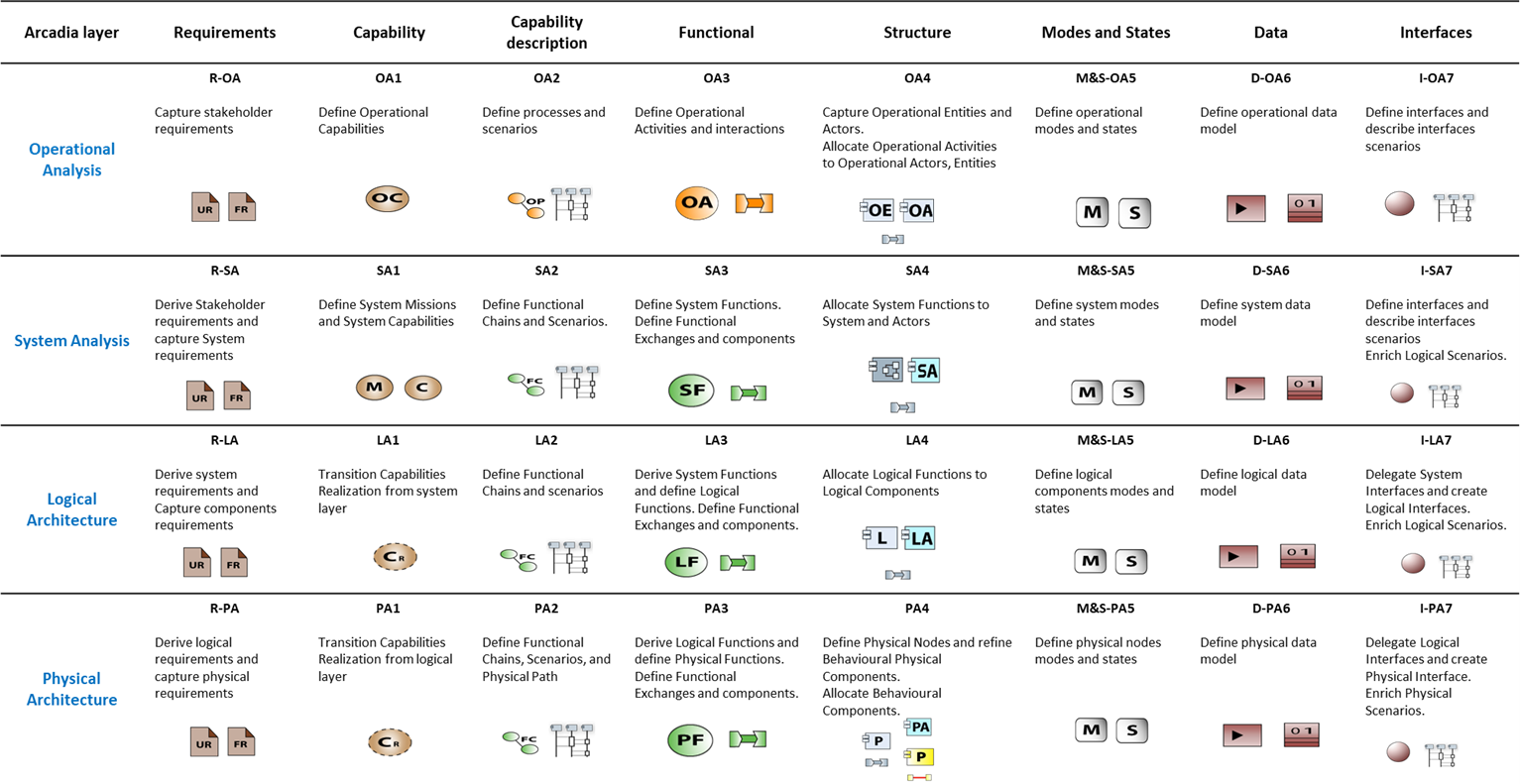
Arcadia is a tooled method devoted to systems & architecture engineering, supported by Capella modelling tool.
It describes the detailed reasoning to
It can be applied to complex systems, equipment, software or hardware architecture definition, especially those dealing with strong constraints to be reconciled (cost, performance, safety, security, reuse, consumption, weight…).
It is intended to be used by most stakeholders in system/product/software or hardware definition and IVVQ as their common engineering reference and collaboration support.
Arcadia stands for ARChitecture Analysis and Design Integrated Approach.
A series of online documents to dive into the principles and concepts of Arcadia:
Arcadia is a system engineering method based on the use of models, with a focus on the collaborative definition, evaluation and exploitation of its architecture.
This book describes the fundamentals of the method and its contribution to engineering issues such as requirements management, product line, system supervision, and integration, verification and validation (IVV). It provides a reference for the modeling language defined by Arcadia.
Jean-Luc Voirin, leader of the creation of the Arcadia method, along with some of the leaders on developing and deploying MBSE Arcadia & Capella practices in Thales. From right to left: Pierre Nowodzienski, Jean-Luc Voirin, Juan Navas, Stephane Bonnet, Frederic Maraux, Gerald Garcia, Philippe Fournies, Eric Lepicier.
Architecture as prime engineering driver
Arcadia, a model-based engineering method
Noticeable features of Arcadia
Definition of the Problem - Customer Operational Need Analysis
Formalization of system requirements - System Need Analysis
Development of System Architectural Design - Logical Architecture (Notional Solution)
Development of System Architecture - Physical Architecture
Formalize Components Requirements - Contracts for Development and IVVQ
Co-Engineering, Sub-Contracting and Multi-Level Engineering
Adaptation of Arcadia to Dedicated Domains, Contexts, Etc.
Equivalences and Differences between SysML and Arcadia/Capella
Entertainment in 2013 was undergoing a massive transition. Streaming was becoming the norm, and the Cielociations Evolution mindset embraced this by prioritizing high-definition output and social connectivity. It wasn't just about watching a film; it was about the setup, the curation, and the digital "vibe" created around the content. Why "Evolution" Mattered
Note: This article is written for informational and archival purposes regarding digital trends of the 2010s. It discusses the software ecosystem of the time, the risks of unauthorized software ("cracks"), and the cultural shift in lifestyle and entertainment. Ciel Associations Evolution 2013 Crack
This article explores the legacy of the Cielociations Evolution 2013 crack, its impact on the lifestyle of the independent creator, and how it fundamentally altered the entertainment landscape by democratizing (and endangering) professional tools. Entertainment in 2013 was undergoing a massive transition
Channels like VanossGaming , PewDiePie (at his peak), and Kwebbelkop relied on visual punchlines that were impossible without multi-track layering and advanced effects. While they eventually went legitimate, their early growth was fueled by cracked software. Why "Evolution" Mattered Note: This article is written
However, the spirit of the crack lives on. Today, that same lifestyle is supported by:
In 2013, a crack for Ciel Associations emerged, allowing users to bypass the software's licensing and activation requirements. The crack, which was widely shared on online forums and file-sharing platforms, gave users access to the software's premium features without having to pay for them. While some users saw the crack as a way to save money, others were concerned about the potential risks and consequences of using pirated software.